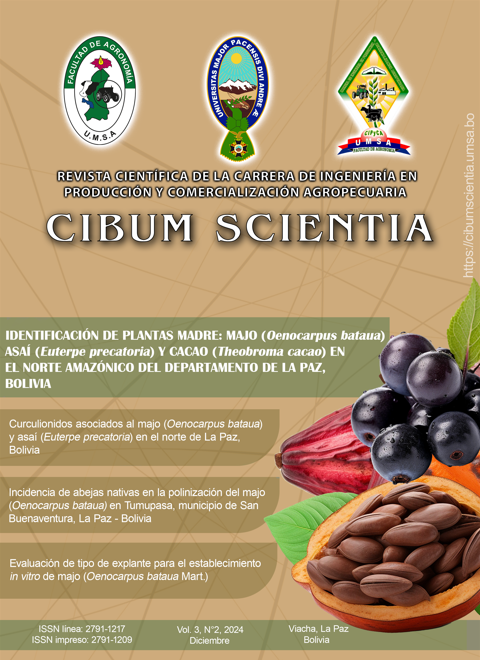
Evaluation of explant type for the in vitro establishment of majo (Oenocarpus batauaMart.)
DOI:
https://doi.org/10.53287/nedd1152pp51qKeywords:
majo, establishment, explant, in vitro, contaminationAbstract
The majo (Oenocarpus batauaMart.), as it is known in Bolivia, is a plant native to the neotropical zone (South America). The study aims to evaluate the efficiency of in vitro establishment of the species Oenocarpus bataua Mart. using different types of explants: embryo and root. The research was carried out at the Biotechnology Laboratory of the Sapecho Experimental Station, in the department of La Paz, Bolivia. The work wascarried out from September 2023 to June 2024. The objective was to determine the type of explant (embryo or root) most suitable for in vitro establishment. Embryo and root explants were used, subjected to disinfection processes and in vitro culture in a specific culture medium.Variables such as the percentage of total contamination, contamination by fungi, bacteria and oxidation, as well as the percentage of survival and germination were measured. The results showed that embryonic explants presented a lower rate of total contamination (40.74 %), fungal and bacterial contamination compared to root explants (66.67 %). However, embryonic explants presented a higher rate of oxidation (9.26 %). In terms of survival, embryonic explants showed a higher germinationrate (46.3 %), although not all explants survived. It is concluded that embryonic explants of O. batauaMart. are more suitable for in vitro establishment due to lower susceptibility to contamination and higher germination rate. Further studies on embryonic explants are recommended.
Downloads
Published
How to Cite
Issue
Section
License
Copyright (c) 2024 Maria Isabel Llusco Tarqui, Félix Fernando Manzaneda Delgado, Marco Antonio Echenique Quezada, Juan José Aparicio Porres, Jose Luis Calle Peralta

This work is licensed under a Creative Commons Attribution-NonCommercial-ShareAlike 4.0 International License.
CIBUM SCIENTIA Scientific Journal is licensed under CC BY-NC-SA 4.0.©
AUTHORS RETAIN THEIR RIGHTS:
Authors retain their trademark and patent rights, as well as any rights to any process or procedure described in the article.
Authors retain the right to share, copy, distribute, perform, and publicly communicate the article published in the CIBUM SCIENTIA Scientific Journal (for example, placing it in an institutional repository or publishing it in a book), with acknowledgment of its initial publication in the CIBUM SCIENTIA Scientific Journal.
Authors retain the right to subsequently publish their work, to use the article or any part thereof (e.g., a compilation of their works, conference notes, theses, or for a book), provided that they indicate the source of publication (authors of the work, journal, volume, issue, and date).