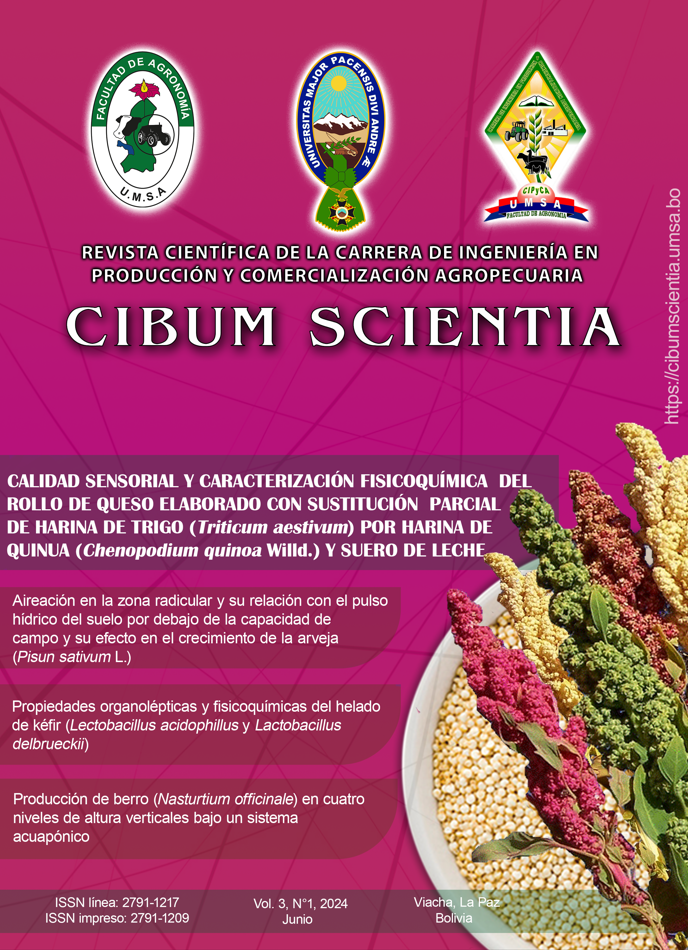
Aeration in the root zone and its relationship with soil water pulses below field capacity and their effect on the growth of pea (Pisum sativumL.)
DOI:
https://doi.org/10.53287/gych5119pm55oKeywords:
pea, saturation, aeration, field capacity, growth, rateAbstract
The work was carried out in the Engineering Degree in Agricultural Production and Marketing, Universidad Mayor de San Andrés, with the objective of evaluating saturation at the root level in the pea crop, considering that the decrease in oxygen generates physiological problems in the crop. Plant height, leaf area, absolute growth rate, relative and absolute growth rate were evaluated with intervals of seven days, in addition to destructive sampling up to 98 days. The objective was to evaluate the effect of water saturation with three percentages of water replacement and its effect on the growth of the pea plant. For plant height, the AP75% treatment reached 144.0 cm, AP50% with 99.85 cm, AP25% with 99.12 cm. The leaf area was greater in AF75% with 3,509.55 cm2/treatment, AF50% and AF25% with 1,790.47 cm2and 1,717.73 cm2respectively. The TCA75% with 2.30 g/day, followed by the TCA50%, TCA25% treatments with 1.16 g/day and 1.05g/day. The relative growth rate was lower up to 60 days, increasing thereafter. The highest rate corresponds to TCR75%, in the senescence phase it tends to decrease with 0.0430442 g g/day. TAN75% reached 0.00002045 g/cm2/day followed by TAN50% with 0.00001758 g/cm2/day, finally the TAN25% treatment reached 0.00001626 g/cm2/day. With a saturation at 75% of its field capacity, the pea crop presents better growth indicators.
Downloads
Published
How to Cite
Issue
Section
License
Copyright (c) 2024 Brigido Moises Quiroga Sossa, José Eduardo Oviedo Farfán, Cristal Taboada Belmonte, Yhessica Calle Aliaga, Teófilo Mauricio Castañeta Mamani

This work is licensed under a Creative Commons Attribution-NonCommercial-ShareAlike 4.0 International License.
CIBUM SCIENTIA Scientific Journal is licensed under CC BY-NC-SA 4.0.©
AUTHORS RETAIN THEIR RIGHTS:
Authors retain their trademark and patent rights, as well as any rights to any process or procedure described in the article.
Authors retain the right to share, copy, distribute, perform, and publicly communicate the article published in the CIBUM SCIENTIA Scientific Journal (for example, placing it in an institutional repository or publishing it in a book), with acknowledgment of its initial publication in the CIBUM SCIENTIA Scientific Journal.
Authors retain the right to subsequently publish their work, to use the article or any part thereof (e.g., a compilation of their works, conference notes, theses, or for a book), provided that they indicate the source of publication (authors of the work, journal, volume, issue, and date).