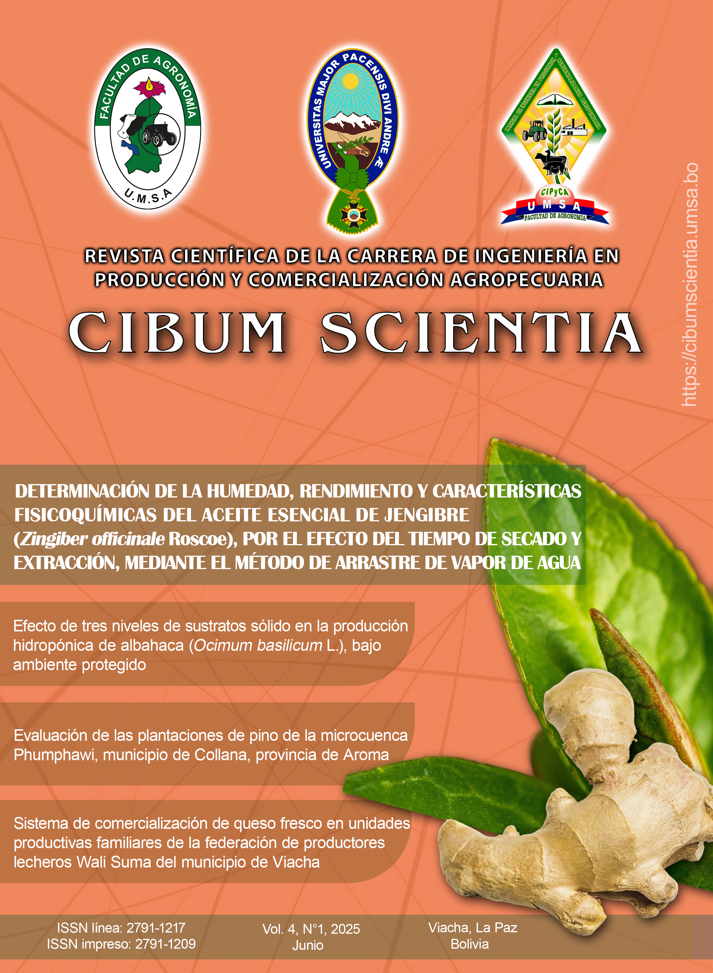
Determination of moisture, yield and physicochemical characteristics of ginger (Zingiber officinaleRoscoe) essential oil, by the effect of drying and extraction time, using the water vapor entrainment method
DOI:
https://doi.org/10.53287/qatj8584se28pKeywords:
Zingiber officinaleRoscoe, essential oil, water vapor entrainment method, humidityAbstract
Ginger is one of the most widespread natural remedies in the world and with more properties and medicinal applications for different pathologies. In Bolivia, it is one of the medicinal plants produced in the lowlands, currently, it is very recognized worldwide for its excellent anticancer and antiviral qualities. The objective of the research is to determine the humidity, yield and physicochemical characteristics of the essential oil of ginger, by the effect of drying and extraction time, using the method of water vapor entrainment. To determine the percentage of rhizome moisture and the optimum extraction time of the essential oil in ginger, the design was conducted under a completely randomized design, where the percentage of moisture was evaluated from three dryingtimes, determination of the yield of ginger essential oil from three extraction times and the physicochemical characteristics of essential oil (relative density, refractive index, acidity index and solubility in ethanol) were determined. In the results obtained the moisture percentage of MS ginger, in the three drying times on average gave the values of: TA H: 12.21(72 h) %, TBH: 12.01% (82 h) and TCH: 11.85 % (120 h). The best yield of ginger essential oil was obtained with the TAC treatment (0.48 %/150 gDM of ginger), with a humidity of 11.80 %, for 5 h, applying the water vapor entrainment extraction method. Due to the results obtained in the physicochemical tests carried out on the essential oil of ginger, which are within the Bolivian Standards NB 75022, such as: relative density and refractive index, miscibility in ethanol and acidity index, this indicates that the product obtained is of good quality and natural.
Downloads
Published
How to Cite
Issue
Section
License
Copyright (c) 2025 Jhannet Condori Clares, Delia Georgina Burgoa Fernandez, Gladys J. Chipana Mendoza

This work is licensed under a Creative Commons Attribution-NonCommercial-ShareAlike 4.0 International License.
CIBUM SCIENTIA Scientific Journal is licensed under CC BY-NC-SA 4.0.©
AUTHORS RETAIN THEIR RIGHTS:
Authors retain their trademark and patent rights, as well as any rights to any process or procedure described in the article.
Authors retain the right to share, copy, distribute, perform, and publicly communicate the article published in the CIBUM SCIENTIA Scientific Journal (for example, placing it in an institutional repository or publishing it in a book), with acknowledgment of its initial publication in the CIBUM SCIENTIA Scientific Journal.
Authors retain the right to subsequently publish their work, to use the article or any part thereof (e.g., a compilation of their works, conference notes, theses, or for a book), provided that they indicate the source of publication (authors of the work, journal, volume, issue, and date).