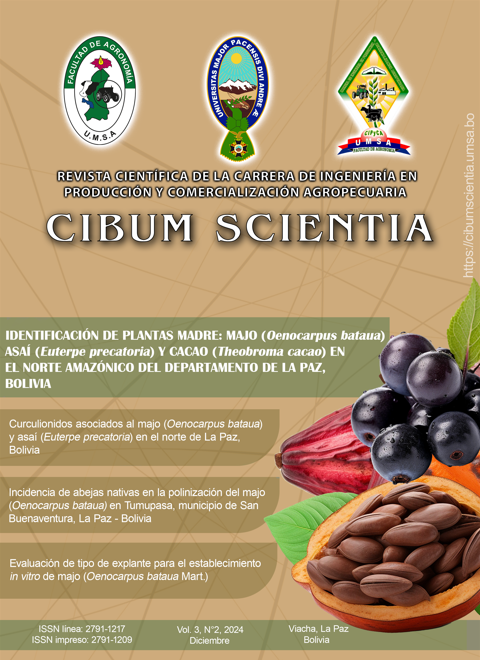
Curculionids associated with the majo (Oenocarpus bataua) and asaí (Euterpe precatoria) in northern La Paz, Bolivia
DOI:
https://doi.org/10.53287/vevv4969cq36dKeywords:
pollination, palms, Curculionidae, asaí, majoAbstract
Bolivia's Amazon forest is a strategic area of special protection for the integral development of the country due to its high forestry potential. Recently, there has been an increase in demand for various forest products such as fruits of palm trees like the asaí and majo, but the pollination of these and other palms has not been studied in Bolivia, nor have their pollinating agents. According to the literature, the main pollinators of asaí are bees and beetles, while for majo, the main pollinators are beetles, especially beetles of the superfamily Curculionoidea. Thus, this study aims to determine the richness and abundance of Curculionoidea associated with majo and asaí in northern La Paz, seeking to deepen the knowledge of groups that are related to the pollination of majo and asaí in two areas of forest dominated by asaí or majo in the ecological system of pre-Andean glacial forests of the southwestern Amazon.Through nocturnal collections with light traps. Twenty-four individuals of the superfamily Curculionoidea were captured, distributed in 14 morphospecies of which 2 genera represent new records for Bolivia and another 2 genera represent new records for the Department of La Paz. Since Coleoptera represent the main palm pollinators in general, the results obtained strengthen the knowledge of groups of relevance for palm pollination. Strengthening the knowledge of palm pollinators not only has an impact on food security but also on energy security in a context where biofuels, whose raw material is palm fruit, are gradually increasing in the national energy matrix.
Downloads
Published
How to Cite
Issue
Section
License
Copyright (c) 2024 Jaime Iván Rodríguez-Fernández, José Luis Calle Peralta, Hugo Daniel Bosque Sánchez

This work is licensed under a Creative Commons Attribution-NonCommercial-ShareAlike 4.0 International License.
CIBUM SCIENTIA Scientific Journal is licensed under CC BY-NC-SA 4.0.©
AUTHORS RETAIN THEIR RIGHTS:
Authors retain their trademark and patent rights, as well as any rights to any process or procedure described in the article.
Authors retain the right to share, copy, distribute, perform, and publicly communicate the article published in the CIBUM SCIENTIA Scientific Journal (for example, placing it in an institutional repository or publishing it in a book), with acknowledgment of its initial publication in the CIBUM SCIENTIA Scientific Journal.
Authors retain the right to subsequently publish their work, to use the article or any part thereof (e.g., a compilation of their works, conference notes, theses, or for a book), provided that they indicate the source of publication (authors of the work, journal, volume, issue, and date).