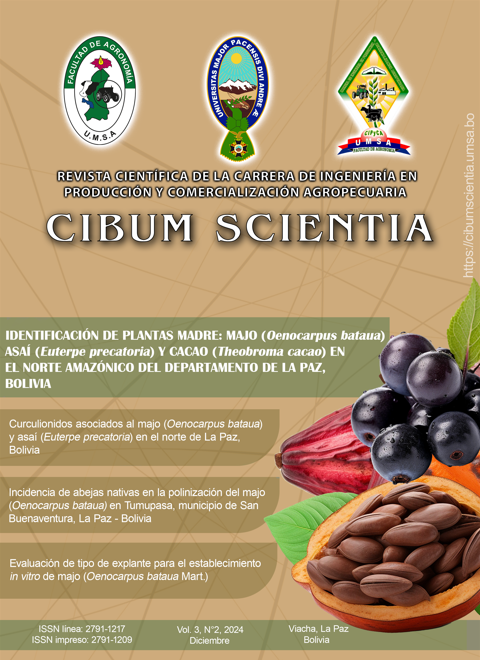
Incidence of native bees in the pollination of majo (Oenocarpus bataua) in Tumupasa, Municipality of San Buenaventura,La Paz-Bolivia
DOI:
https://doi.org/10.53287/rfvq6313yt13pKeywords:
pollination, native bee, majo, O. bataua, Tumupasa, San BuenaventuraAbstract
The majo (O. bataua) palm tree that in recent years has attracted the attention of producers, companies and the central government of Bolivia, due to the productive potential it presents due to its nutritional characteristics and demand in the national market, which which led us to carry out this study, with the objective of knowing the incidence of five types of native bees (Trigona sp.,Partamona sp.,T. angustula,Oxytrigona sp.,Plebeia sp.), in the pollination of majo fruits. The methodology was used a. identification of the meliponary with the established hives, b. spatial analysis of the distribution of majo palms, c. analysis of the extracted pollen, d. description and discussion of the results obtained. Where it was found, more pollen grains could be identified in the sample from the hive of the species Trigona sp.(average of 7 pollen grains sample 10 u/l), followed by the genus Plebeia sp. (average of 3 pollen grains sample 10 u/l), followed by Oxytrigona sp. (average of 2,4 pollen grains sample 10 u/l), followed byT. angustula(average of 2,2 pollen grains sample 10 u/l); However, the genus Partamona sp.very few pollen grains could be observed and in some repetitions none. Since this is a descriptive study, it is necessary to continue with the analyzes at different collection times and types of melipona bees.
Downloads
Published
How to Cite
Issue
Section
License
Copyright (c) 2024 Jose Luis Calle Peralta, Virginia Huanca Choque, Waldir German Cruz Perez, Maria Isabel Llusco Tarqui, Javier Alfredo Nuñez Villalba, David Cruz Choque

This work is licensed under a Creative Commons Attribution-NonCommercial-ShareAlike 4.0 International License.
CIBUM SCIENTIA Scientific Journal is licensed under CC BY-NC-SA 4.0.©
AUTHORS RETAIN THEIR RIGHTS:
Authors retain their trademark and patent rights, as well as any rights to any process or procedure described in the article.
Authors retain the right to share, copy, distribute, perform, and publicly communicate the article published in the CIBUM SCIENTIA Scientific Journal (for example, placing it in an institutional repository or publishing it in a book), with acknowledgment of its initial publication in the CIBUM SCIENTIA Scientific Journal.
Authors retain the right to subsequently publish their work, to use the article or any part thereof (e.g., a compilation of their works, conference notes, theses, or for a book), provided that they indicate the source of publication (authors of the work, journal, volume, issue, and date).