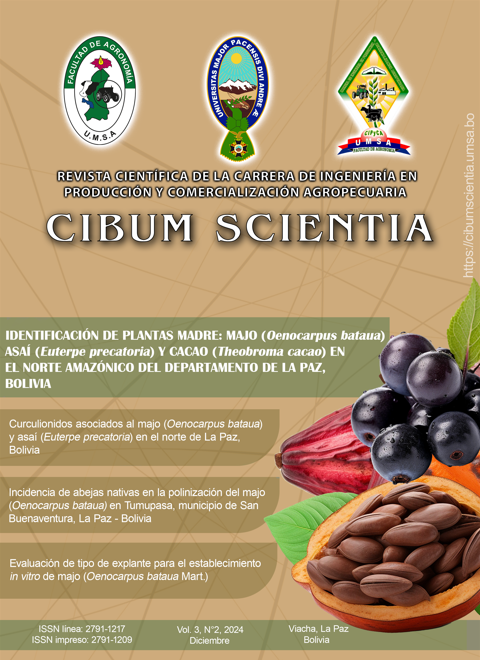
Identification of mother plants: majo (Oenocarpus bataua), asai (Euterpe precatoria) and wild cacao (Theobroma cacao) in the northern Amazonian department of La Paz, Bolivia
DOI:
https://doi.org/10.53287/myzc9394uf64tKeywords:
Bolivian Amazon fruits, identification, mother plantsAbstract
The fruits of the Bolivian Amazon forest such as majo, asai and wild cacao species are of great nutritional and local trade importance; however, they can suffer a decrease in the forest due to logging, flooding and other climatic events, which makes them vulnerable. For this reason, the objective was to identify high production mother plants for the conservation of the three fruit species. Identification protocols were used to characterize and determine the geographic location of mother plants in the municipalities of Palos Blancos, San Buenaventura and Ixiamas. Mother plants of the species were identified in these municipalities. Among the characteristics found were higher production of majo and asai fruit in the communities of Santa Rosa de Maravilla and Carmen Pecha and wild cacao in Carmen del Emero.
Downloads
Published
How to Cite
Issue
Section
License
Copyright (c) 2024 Claudia Adriana Piza Paz, Javier Nuñez Villalba, José Luis Peralta, Luis Ernesto Cuenca Usmayo, Jhon Leonardo Cabrera Espindola, Zenobio Mollo Turco

This work is licensed under a Creative Commons Attribution-NonCommercial-ShareAlike 4.0 International License.
CIBUM SCIENTIA Scientific Journal is licensed under CC BY-NC-SA 4.0.©
AUTHORS RETAIN THEIR RIGHTS:
Authors retain their trademark and patent rights, as well as any rights to any process or procedure described in the article.
Authors retain the right to share, copy, distribute, perform, and publicly communicate the article published in the CIBUM SCIENTIA Scientific Journal (for example, placing it in an institutional repository or publishing it in a book), with acknowledgment of its initial publication in the CIBUM SCIENTIA Scientific Journal.
Authors retain the right to subsequently publish their work, to use the article or any part thereof (e.g., a compilation of their works, conference notes, theses, or for a book), provided that they indicate the source of publication (authors of the work, journal, volume, issue, and date).